About Eggs In General
Eggs are a complete protein, meaning they have every amino acid your body needs. They have iron, calcium, and every vitamin, except Vitamin C. Some people worry about the fat and cholesterol content of eggs, but current research strongly suggests that dietary cholesterol has much less impact on serum blood cholesterol levels than previously theorized. Most nutritionists will tell you that if you want to lower your cholesterol levels, removing cholesterol and fat from your diet is not the way. It is more important to avoid hydrogenated fats, trans fats and saturated fats specifically.
All the Vitamin A, Vitamin B6, Vitamin D, Thamin, and Vitamin E in an egg is found in the yolk, but just eating the whites still provides protein, choline, Vitamin B12, folate, iron, zinc, calcium, and potassium. While the yolk has more nutrients in it, the white still provides filling protein and a number of essential nutrients. For a breakdown of nutrition info of whites versus yolks, visit the Incredible Egg website.
Cage free eggs cost more than regular eggs because cage free hens are more active than caged hens. Because cage free hens are allowed to roam and engage in their natural behaviors, they use more energy, and thus eat more feed than caged hens. Cage free farmers also spend more time caring for the birds because raising them in a humane, cage free way requires more hands-on time with the hens. Our farmers’ additional time and labor increase our costs. In addition to labor and feed costs, our organic and cage free eggs are more expensive because our hens have specially grown and certified feed.
Floating an egg is not an accurate test for whether an egg has spoiled, but it can tell you more about the age of the egg. Eggs naturally develop an air cell between the egg white and the shell. As the egg ages, the contents of the egg contract, causing the air cell to grow larger. If the air cell grows large enough, the egg can float in water. So, an egg that floats might be older than one that sinks, but that does not mean it is spoiled.
Some eggs have a larger egg cell than others to begin with, so this test is not precise. The best way to tell whether an egg is bad is to break it in a bowl separate from other ingredients. If the egg has appears off color, or has a rotten smell, then do not consume it.
Fresh uncooked eggs in the shell are best kept in the refrigerator in their original cartons. Under these conditions, the eggs will still be at peak quality for up to two to three weeks past the sell-by date.
The white cord is the chalazae (ka-LAY-zee) and is a sign of freshness. The egg white twists here to form a “rope” to anchor to the top and bottom of the shell membrane and center the yolk within the egg.
A red spot in an egg is called a blood spot. Blood spots occur naturally when the hen is laying the egg. They do not mean the egg is fertilized or inedible. They are more common in brown eggs because it is harder to see them during candling (an inspection process used to ensure the quality of our eggs).
It takes a hen about 24 to 26 hours to produce and lay an egg. Fifteen to 30 minutes after she lays her egg, the process starts over again.
No, hens do not need roosters to lay eggs. All a female chicken needs to produce an egg is enough light, food, and water and happy, healthy living conditions.
Both white eggs and brown eggs are completely natural. White eggs are laid by hens with white ears, while brown eggs are laid by hens with brown ears. Despite the shell color, there are no other differences between white and brown eggs, nutritional or otherwise.
About GMOs (Genetically Modified Organisms)
There are not currently genetically modified chickens or eggs on the market. While chickens and eggs themselves are not genetically modified, most chickens in North America are raised on a combination of corn, alfalfa, soy, and canola. All of these crops are very likely to come from GMOs. The majority of genetically engineered crop acres in the United States are used for animal feed and the Non-GMO Project seal requires the ongoing GMO testing of feed at the farms. Avoiding products of animals raised on GMO feed is a way to reduce GMO use and contamination.
Visit the Non-GMO Project website for a list of the most commonly genetically modified products, which should be avoided, as well as a list of products that are Non-GMO Project Verified.
The ecological concerns mainly relate to pesticide use and the eradication of heritage or native species. Because a lot of GMO plants are designed to be pesticide and herbicide resistant, farmers using GMOs can use chemical pesticides on their crops as often as they like. This puts heritage or native species who are not resistant to pesticides at a disadvantage.
Furthermore, GMOs can contaminate native and heritage plants by cross-pollination. In the long-term, this sharing of genetically modified DNA could lead to a lack of natural plant varieties and a change in ecological systems due to the unnatural advantage of GMOs. In the US 93% of current soy crops, 90% of current canola crops, and 86% of current corn crops are GMO. This level of competition between native and GMO plants makes the possibility of native plant destruction very real.
While the National Organic Program (NOP) identifies genetic modification as an excluded method for organic farming, GMOs are not a prohibited substance and GMO tests are not required during organic certifications. This means that although GMO seeds are not supposed to be planted, and GMO ingredients are not supposed to be used on organic farms, but they may be present in those foods. Unfortunately, with most key crops like soy and corn being planted with GMO varieties in North America, contamination of seeds, ingredients, and products is a real risk, even for certified organic products.
The sad truth is that many of the foods that are most popular among children contain GMOs. Cereals, snack bars, snack boxes, cookies, processed lunch meats, and crackers all contain large quantities of ingredients with high GMO risk. In North America, over 80% of our food contains GMOs. If you are not buying foods that are Non-GMO Project Verified, GMOs are likely present in your diet.
One scientific study shows that the altered DNA from GMO plants remains in people’s digestive tracts. From a food safety standpoint, as genetic modifications are unnatural DNA changes, this is enough to worry people.
More studies have been done on laboratory animals. These studies found several problems related to ingesting GMOs including increased toxicity, organ damage, and changes in blood chemistry.
Most developed nations do not consider GMOs to be safe. In nearly 50 countries around the world, including Australia, Japan, the United Kingdom and all the countries in the European Union, there are significant restrictions or outright bans on the production and sale of GMOs.
The Non-GMO Project Verified seal indicates that the product bearing it has been verified by the Non-GMO Project. The verification process ensures that the product has been produced according to consensus-based best practices for GMO avoidance.
Non-GMO Project Verified products have met the following criteria:
1. Ongoing testing of all at-risk ingredients. Any ingredient grown commercially in GMO form must be tested prior to use in a Non-GMO Project Verified product.
2. Testing below the Action Threshold of 0.9%. This is in alignment with laws in the European Union, where any product containing more than 0.9% GMO must be labeled. Absence of all GMOs is the target for all Non-GMO Project Standard compliant products.
3. Continuous improvement practices toward achieving this goal must be part of the participant’s quality management systems.
4. Rigorous traceability and segregation practices to ensure ingredient integrity through to the finished product.
5. An annual audit and onsite inspections for high-risk products.
The Non-GMO Project is a non-profit 501(c)3 organization that was founded on the idea that people in North America should always have access to clearly labeled, non-GMO products and foods. That conviction is the guiding force behind the Non-GMO Project, which offers North America’s only independent verification for products made according to best practices for GMO avoidance. Now, thanks to The Non-GMO Project, shoppers everywhere can look to the Non-GMO Project Verified logo on all their favorite food categories for the peace of mind that their food is not being produced from genetically modified sources.
GMOs, or “Genetically Modified Organisms,” are plants or animals created through the gene splicing techniques of biotechnology (also called genetic engineering, or GE). Genetically modified plants and animals have had their DNA irrevocably changed in a way that can’t be replicated in nature.
One of the most widely used GMO plants is the soybean. These beans have an herbicide resistant gene from bacteria inserted into their DNA. Such a trans-species, even trans-kingdom, DNA mutation is impossible in the natural world because bacteria would never be able to breed with a soybean plant.
About NestFresh Eggs
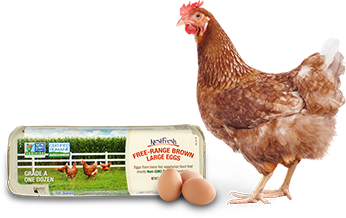
The shells of NestFresh Pasture Raised Eggs have natural variations in color. Even though they are all brown eggs and come from a breed of hens that lay brown eggs, some are lighter in color than others. This variation is due to the fact that the hens have access to pastures where they get plenty of sunlight. High levels of sunlight help the hens produce extra vitamin D, which then lightens the color of their eggs’ shells.
In 2012 California voters passed Proposition 2, which required laying hens in California to have enough space to lie down, stand up, fully extend their limbs and turn around freely. The California state legislature then passed companion bill AB1437 to require that eggs produced out of state, but sold in California, must also meet this requirement.
The changes in California law do not affect us because we have always been 100% cage free. Our hens have plenty of room to roam, jump on perches and socialize with other hens when inside our barns.
Our labels are marked “CA SEFS Compliant” to comply with regulations in California. The statement denotes that our practices comply with the California Shell Egg Food Safety regulations, which requires salmonella testing and bird vaccination, as well as a minimum amount of floor space allotted per bird in our barns.
NestFresh shell eggs are not pasteurized. They should be cooked according to the safe handling instructions on the carton. NestFresh liquid egg whites and liquid egg products are pasteurized. NestFresh Hard Cooked Eggs are fully cooked and ready-to-eat.
Our free-range, Non-GMO, pasture raised, and organic hens have outdoor access. The size of the pasture they have access to varies depending on the farm and the type of egg. For instance, our pasture raised hens have at least 108 square feet per bird when they are outside.
No, NestFresh never uses any hormones or antibiotics.
No, our eggs are not fertilized.
Yes, our all natural feed contains corn and soy along with vitamins and other ingredients that support healthy hens and quality eggs.
Our Soy Free Eggs come from hens fed a similar feed as our other hens, but it does not include any soy ingredients.
NestFresh Eggs are available nationwide in a number of specialty and regular grocery stores. Visit our Where to Buy page to find a list of retailers that carry our eggs in your state.
Our hens are fed a nutritious vegetarian diet that never contains antibiotics, hormones, steroids, or animal by-products. Our NestFresh Organic Eggs come from birds given feed that is certified organic by a third-party certifier. Our hens who lay NestFresh Non-GMO Eggs eat Non-GMO Project Verified feed.
100% cage free means that NestFresh hens are never confined to cages. Our eggs always come from hens that live in spacious barns where they are free to socialize with other birds, perch, dustbathe, and lay their eggs in peaceful nesting boxes.